|
|
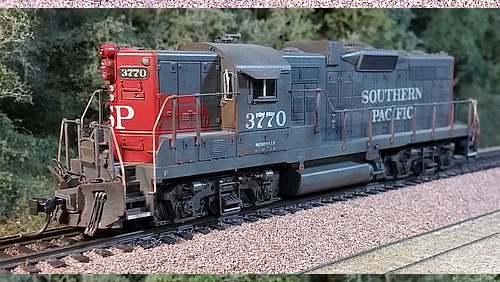
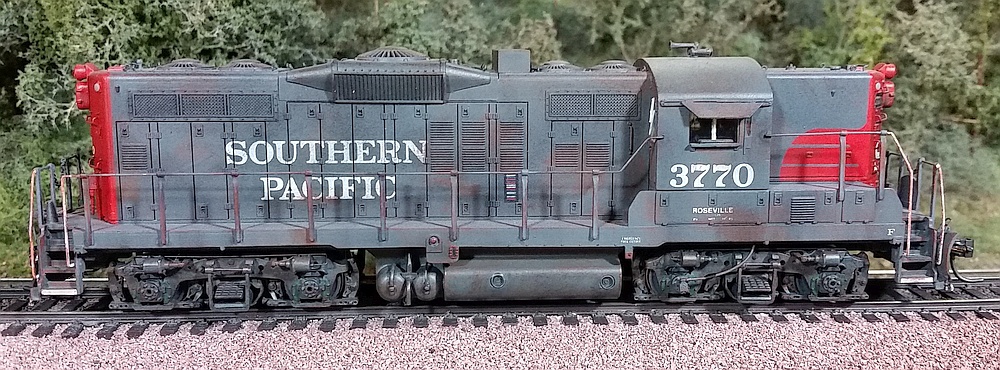
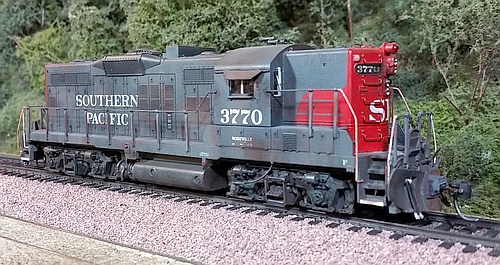
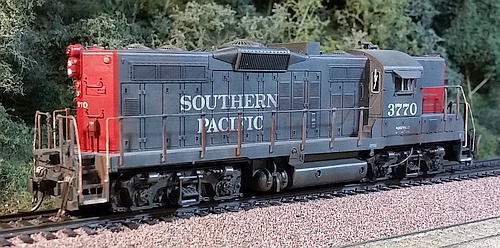
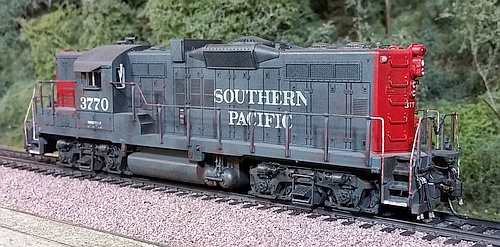
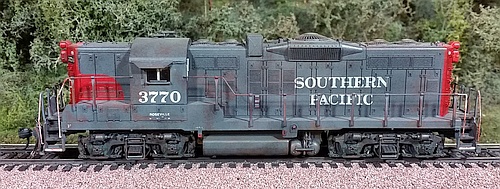
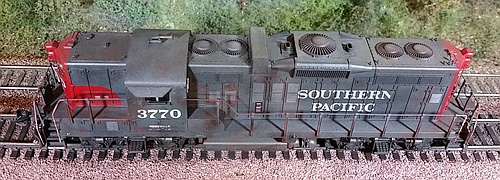





















SP GP9e 3770
This model was constructed around 1990 from a Front Range brand GP9,
with a Mashima can motor added. I installed numerous detail parts, as well as
custom painting and weathering to capture the essence of a typical rebuilt SP GP9e.
More recently, I installed Soundtraxx Tsunami2 sound decoder,
Scale Sound Systems speaker, TCS Keep-Alive, and LED lighting.
This model was constructed around 1990 from a Front Range brand GP9,
with a Mashima can motor added. I installed numerous detail parts, as well as
custom painting and weathering to capture the essence of a typical rebuilt SP GP9e.
More recently, I installed Soundtraxx Tsunami2 sound decoder,
Scale Sound Systems speaker, TCS Keep-Alive, and LED lighting.
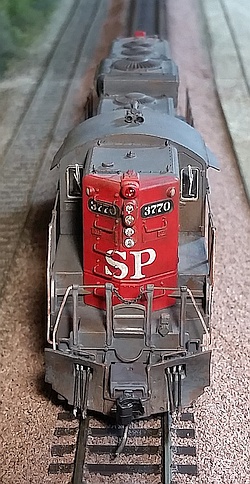
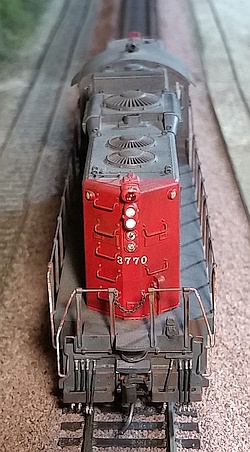
For this GP9e, I went whole hog with the full SP light packages at
both ends. The distinctive rooftop air filter box was fabricated from
a length of rectangular styrene tube capped at each end with styrene
sheet. Small access doors were grafted into the ends below the
number boards. Added plumbing was installed on the air tanks
behind the fuel tank. The skirting along the side sills was modified
per prototype photos. Compare the fan arrangement to SP 3882.
both ends. The distinctive rooftop air filter box was fabricated from
a length of rectangular styrene tube capped at each end with styrene
sheet. Small access doors were grafted into the ends below the
number boards. Added plumbing was installed on the air tanks
behind the fuel tank. The skirting along the side sills was modified
per prototype photos. Compare the fan arrangement to SP 3882.
-- About
-- Contact
-- Diesels
-- Links
Above: My photo of 3770 in the
early 1980's inspired my model.
Right: A photo I found on the
internet of 3770 in 1975. Turns
out the rear red warning light and
oscillating light were removed, so
my model is not accurate here.
This would be a simple thing to
fix if I chose to.
early 1980's inspired my model.
Right: A photo I found on the
internet of 3770 in 1975. Turns
out the rear red warning light and
oscillating light were removed, so
my model is not accurate here.
This would be a simple thing to
fix if I chose to.
entire website copyright Gregg Fuhriman
created with CoffeeCup Visual Site Designer
created with CoffeeCup Visual Site Designer
-- Layouts
-- Modules
-- Signalling
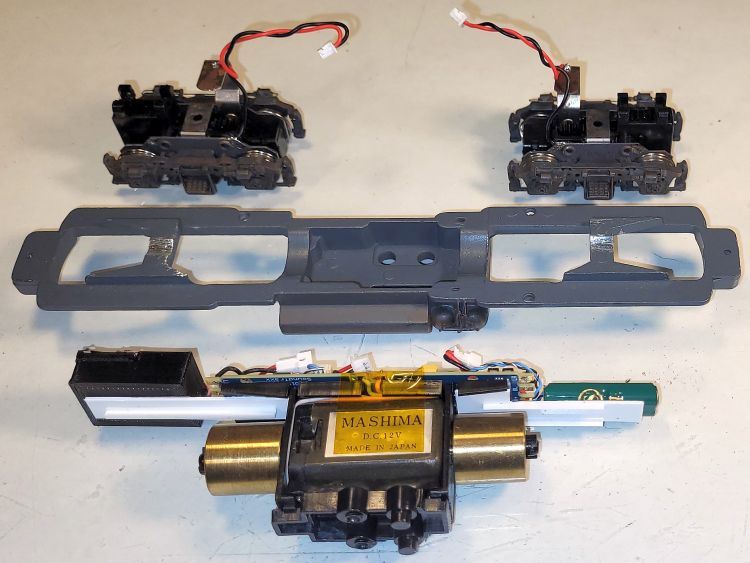
Right: 3770 has my current DCC
install practices. I solder 2-pin
mini-connectors to the trucks'
metal plates, thereby avoiding
reliance on metal-to-metal contact
for electrical pickup. The mini-
connectors make it easy to
remove the trucks for cleaning
and lubrication.
I use styrene to build a platform
that is taped or glued on top the
motor. The platform provides
mounting surfaces for the DCC
decoder, speaker, and Keep-
Alive. The entire assembly is
easily removable for servicing.
I also install mini-connectors for
the lights mounted in the shell,
so the shell is easily detachable
from the drive/decoder. In this
case a 4-pin connector is used:
one pin for the common function
power, one for the front headlight.
one for rear light, and one for the
front gyralight.
install practices. I solder 2-pin
mini-connectors to the trucks'
metal plates, thereby avoiding
reliance on metal-to-metal contact
for electrical pickup. The mini-
connectors make it easy to
remove the trucks for cleaning
and lubrication.
I use styrene to build a platform
that is taped or glued on top the
motor. The platform provides
mounting surfaces for the DCC
decoder, speaker, and Keep-
Alive. The entire assembly is
easily removable for servicing.
I also install mini-connectors for
the lights mounted in the shell,
so the shell is easily detachable
from the drive/decoder. In this
case a 4-pin connector is used:
one pin for the common function
power, one for the front headlight.
one for rear light, and one for the
front gyralight.
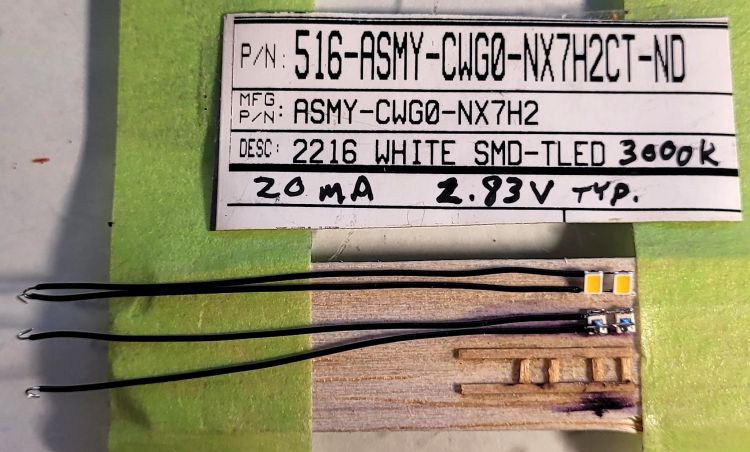
Right: Over the years I've used a
variety of surface-mount LEDs for
locomotive lighting.
For 3770, here is the type I used,
acquired from Digi-Key. They are
rather small and therefore difficult
to handle. To solve this, I made a
simple wooden jig - wood so it
won't melt during soldering. The
LEDs were held in the jig at the
proper spacing and orientation
while I soldered on small-gauge
solid-core wires.
These LED/wire assemblies were
then ACC-glued into the shell
directly behind the light housings,
resulting in bright headlights.
The 4-pin mini-connector was
then soldered to the LED wires.
variety of surface-mount LEDs for
locomotive lighting.
For 3770, here is the type I used,
acquired from Digi-Key. They are
rather small and therefore difficult
to handle. To solve this, I made a
simple wooden jig - wood so it
won't melt during soldering. The
LEDs were held in the jig at the
proper spacing and orientation
while I soldered on small-gauge
solid-core wires.
These LED/wire assemblies were
then ACC-glued into the shell
directly behind the light housings,
resulting in bright headlights.
The 4-pin mini-connector was
then soldered to the LED wires.