|
|





















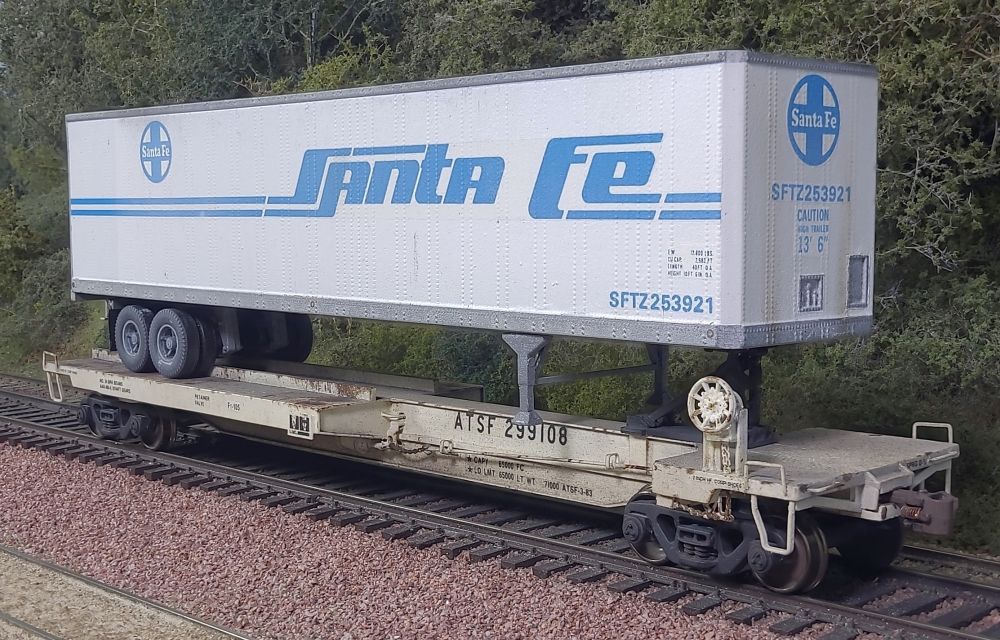
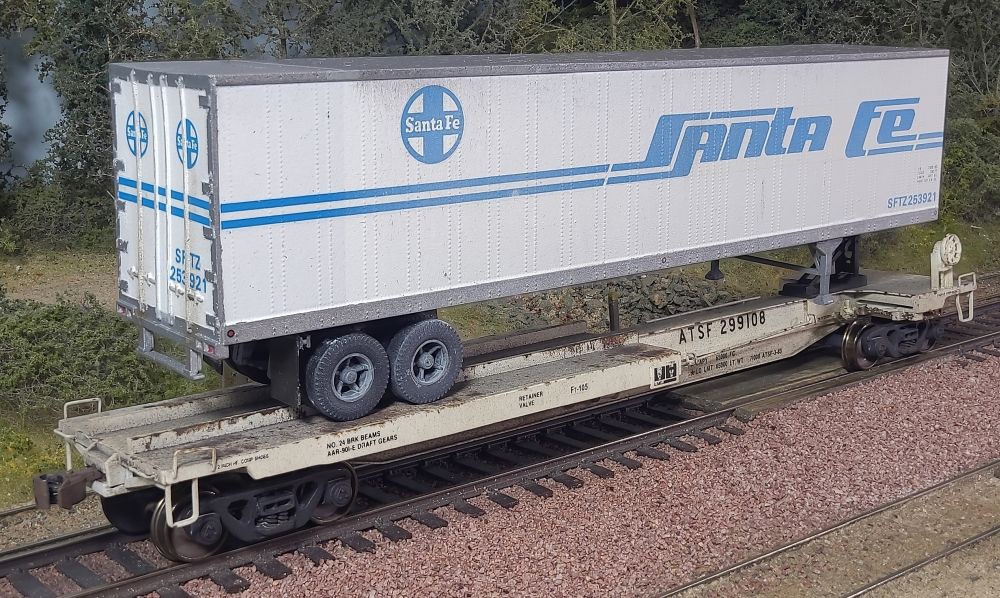

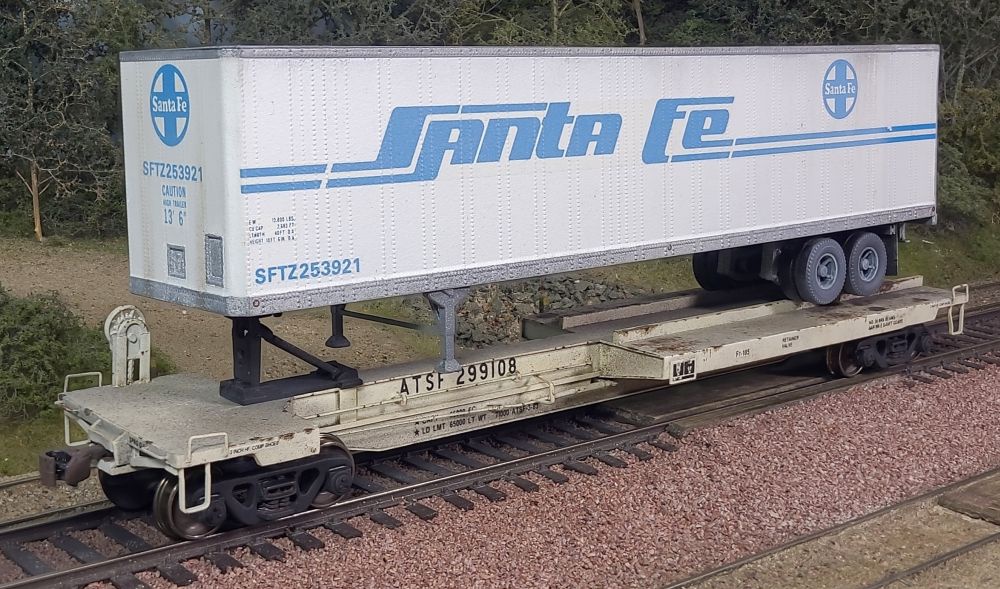













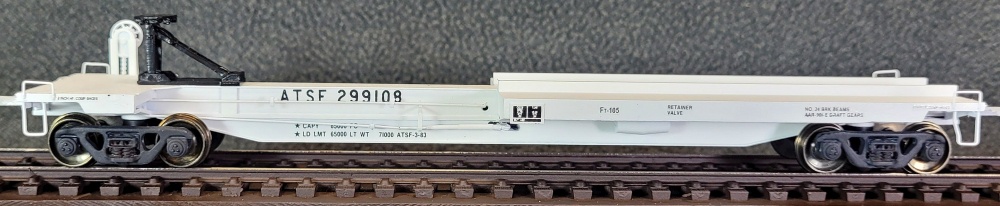
ATSF Ft-105 299108 TOFC Conversion
When the intermodal boom exploded in the early 1980's, Santa Fe needed lots
more trailer-on-flat-car (TOFC) platforms to handle all the new traffic. The
railroad shop forces met the challenge by converting hundreds of older freight
cars into light-weight flat cars specialized for trailer loading. The Ft-105 class
was rebuilt from Bx-74 and Bx-75 50-foot boxcars starting in 1983. Most, if not
all, were painted white with black markings. All were retired by mid-1991.
I made my Ft-105 model from a Front Range kit, heavily modified, with
added brake rigging and other details including grabs, stirrups, rub rails,
and a trailer hitch. Decals came from an assortment of Microscale sets.
When the intermodal boom exploded in the early 1980's, Santa Fe needed lots
more trailer-on-flat-car (TOFC) platforms to handle all the new traffic. The
railroad shop forces met the challenge by converting hundreds of older freight
cars into light-weight flat cars specialized for trailer loading. The Ft-105 class
was rebuilt from Bx-74 and Bx-75 50-foot boxcars starting in 1983. Most, if not
all, were painted white with black markings. All were retired by mid-1991.
I made my Ft-105 model from a Front Range kit, heavily modified, with
added brake rigging and other details including grabs, stirrups, rub rails,
and a trailer hitch. Decals came from an assortment of Microscale sets.
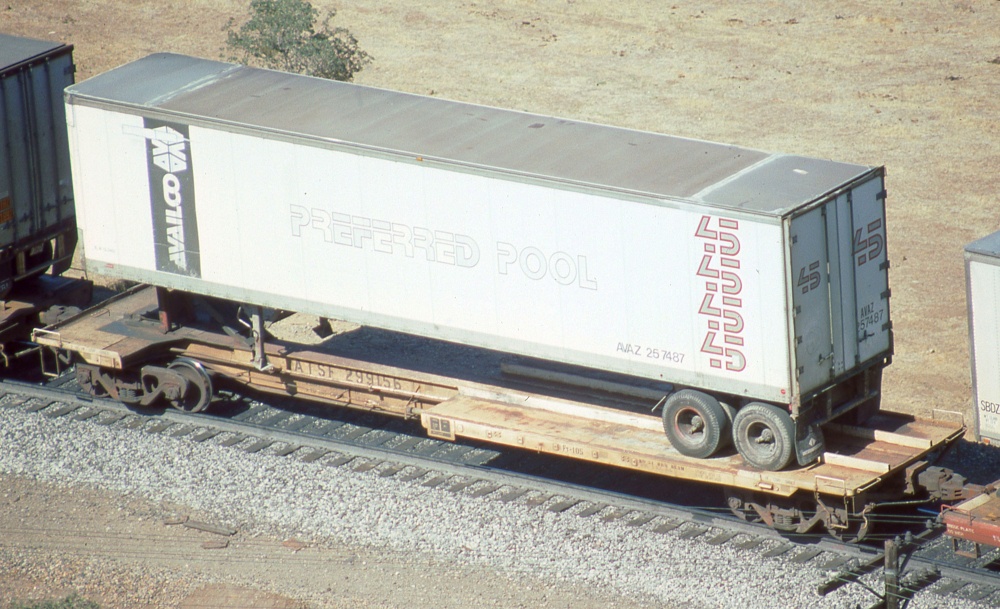
Below: I caught ATSF 299156 from above on Tehachapi Loop, providing crucial info about the deck details. These white cars weathered
to a yellowish beige, which I tried to replicate using artist oils and powdered chalks. Also - a nice top-down shot of an Availco 45' trailer.
to a yellowish beige, which I tried to replicate using artist oils and powdered chalks. Also - a nice top-down shot of an Availco 45' trailer.
-- About
-- Contact
-- Diesels
-- Links
entire website copyright Gregg Fuhriman
created with CoffeeCup Visual Site Designer
created with CoffeeCup Visual Site Designer
-- Layouts
-- Modules
-- Signalling
Below: I photographed ATSF 299187 passing through Stockton, CA. This is the right side showing the slack adjuster and train-line piping.
Below: This shot of ATSF 299204 shows the left side brake rigging including cylinder, rods and chains, and brake wheel and chain guide.
And a good shot of an unusual SP trailer. Thanks to the photographer who shared this image online!
And a good shot of an unusual SP trailer. Thanks to the photographer who shared this image online!
Right: I started with a Front Range
"TOFC converted flat car" kit.
These can still be found for sale
on eBay, etc.
The kit has an open deck area
toward the B end. I removed the
underframing from this area, as
well as portions of the sidesills,
to create the "spine car" design
of the Ft-105 car.
The kit also includes angled
braces for the car ends, which
I modified to look more like the
Santa Fe prototype (see finished
end images, above).
"TOFC converted flat car" kit.
These can still be found for sale
on eBay, etc.
The kit has an open deck area
toward the B end. I removed the
underframing from this area, as
well as portions of the sidesills,
to create the "spine car" design
of the Ft-105 car.
The kit also includes angled
braces for the car ends, which
I modified to look more like the
Santa Fe prototype (see finished
end images, above).
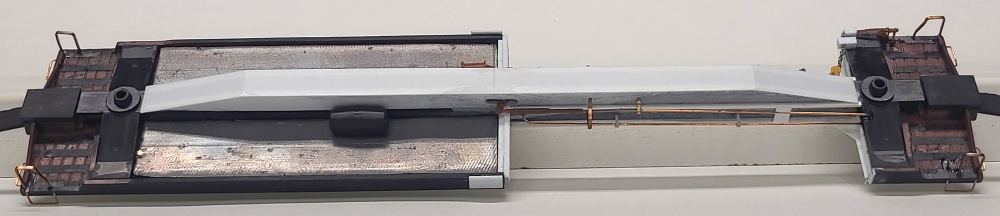
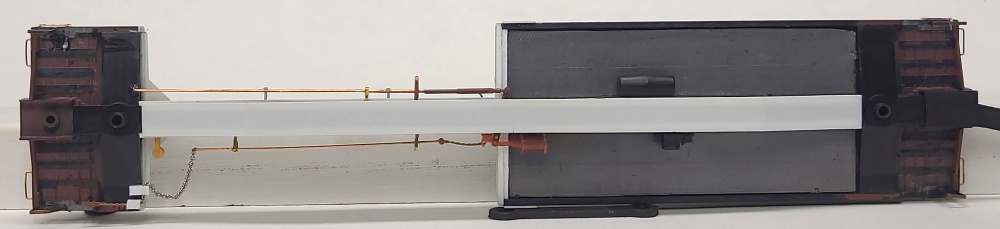
Below: These bottom views of the finished build show the modified underframe and deck underside. I used 0.030" styrene to make new
centersill sides with a deeper "fishbelly" profile matching the prototype car. I buried sheet lead inside the new centersill for added weight, and
used 0.010" sheet styrene to create top and bottom flanges. I also added sheet lead under the trailer wheel platforms. I chose to model only
the most visible brake rigging in the open area along the centersill, so there is no piping etc. connecting to the triple valve. I used styrene to
fabricate angled frame supports with flanges at either end of the open areas, as well as the small chain guides at the B-end bolster. The yellow
bit is a modified part from a well car kit (the chain has fallen off it in these pics - I later glued the chain to the "pulley"). Brake parts are from
various sets from Tichy, Cal-Scale, and Grandt Line (now San Juan Car).
centersill sides with a deeper "fishbelly" profile matching the prototype car. I buried sheet lead inside the new centersill for added weight, and
used 0.010" sheet styrene to create top and bottom flanges. I also added sheet lead under the trailer wheel platforms. I chose to model only
the most visible brake rigging in the open area along the centersill, so there is no piping etc. connecting to the triple valve. I used styrene to
fabricate angled frame supports with flanges at either end of the open areas, as well as the small chain guides at the B-end bolster. The yellow
bit is a modified part from a well car kit (the chain has fallen off it in these pics - I later glued the chain to the "pulley"). Brake parts are from
various sets from Tichy, Cal-Scale, and Grandt Line (now San Juan Car).
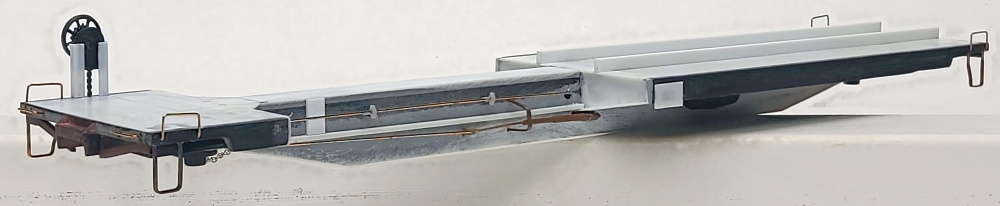
Below: Left side views. I used styrene angle for the brake wheel supports, and brass wire pins for attachment to the deck. I used flat brass
stock bent into loops for the brake rod supports. Styrene strips form the centersill reinforcement and trailer wheel rub rails. Here the angled
framing supports with flanges are visible. I re-profiled the Front Range sidesills to match the Ft-105 design.
stock bent into loops for the brake rod supports. Styrene strips form the centersill reinforcement and trailer wheel rub rails. Here the angled
framing supports with flanges are visible. I re-profiled the Front Range sidesills to match the Ft-105 design.
Below: Right side views. The small gray pipe brackets supporting the wire train line pipe are 3D printed parts I designed in FreeCAD and had
a friend print with his high resolution resin printer. Brake rod supports are formed from flat brass stock. The metal stirrup steps are from A-Line.
a friend print with his high resolution resin printer. Brake rod supports are formed from flat brass stock. The metal stirrup steps are from A-Line.
Below: Top views. I used 0.010" styrene to add a smooth "welded steel" layer over the Front Range deck.
The Details West trailer hitch was added after painting.
The Details West trailer hitch was added after painting.
Below: I airbrushed the entire car white, followed by a coat of gloss in preparation for the decals. For painting, decals, and weathering, I install
"drawbars" in the coupler pockets to act as handles so I don't accidentally get a fingerprint, etc. on the painted model. Once the model is
finished, I replace these with normal Kadee metal couplers. I pieced together decals from several Microscale sets.
"drawbars" in the coupler pockets to act as handles so I don't accidentally get a fingerprint, etc. on the painted model. Once the model is
finished, I replace these with normal Kadee metal couplers. I pieced together decals from several Microscale sets.